Our hybrid platform combines solar PV, battery energy storage, and diesel backup under a unified control architecture to improve reliability, reduce fuel use, and support better power quality across industrial, commercial, and remote applications.
The Smart Hybrid Microgrid integrates solar generation, battery storage, and backup generation into a single operating platform managed through a coordinated energy management system. The result is a more stable, efficient, and controllable power solution for energy users with demanding operating requirements.
A modular architecture allows all energy sources to be integrated through a common DC bus and control layer, enabling scalable deployment and application-specific system design.
N-type TOPCon panels feeding the DC bus via MPPT control
Durable cycling performance, 8,000+ cycle life
Operates only when solar and battery cannot meet load
Solar-priority dispatch, load-responsive operation, SCADA analytics
A modular, scalable platform that integrates all energy sources through a unified DC bus and smart control layer.
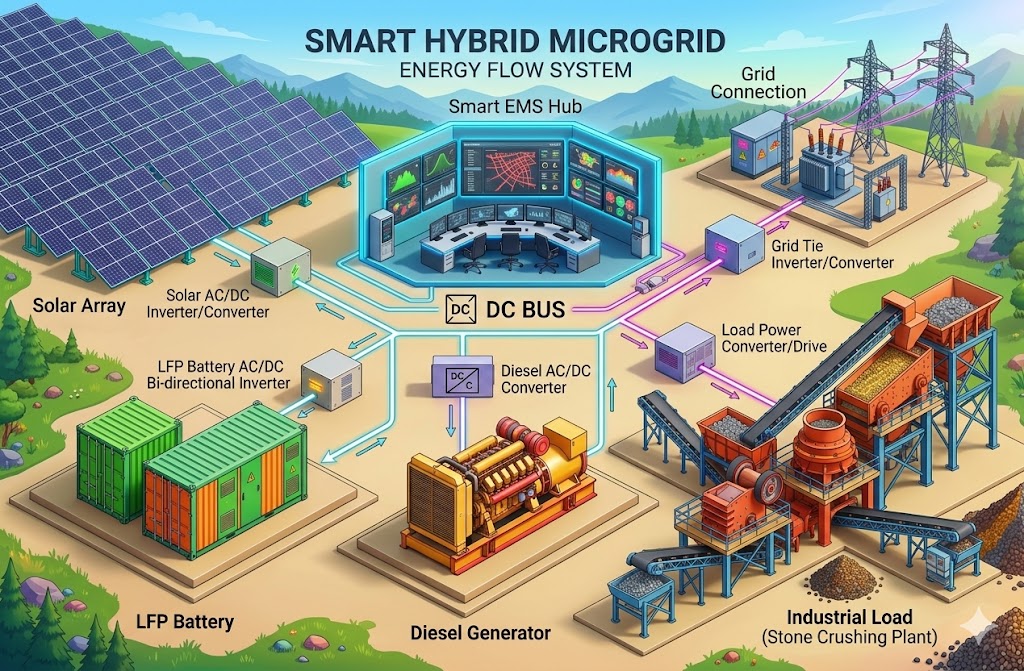
High-efficiency solar modules feed the DC bus through MPPT-based control, supporting dependable daytime energy production.
Lithium iron phosphate storage provides durable cycling performance and stores surplus renewable energy for night-time and peak-demand use.
Backup generation is configured for automatic operation only when solar and battery resources cannot fully support the load, reducing fuel consumption and runtime.
Bidirectional converters manage smooth transitions between energy sources while maintaining continuity of supply.
The control platform enables solar-priority dispatch, load-responsive operation, and monitoring through SCADA-enabled analytics and performance visibility.
Optional grid interconnection can be incorporated for import and export functions in either on-grid or off-grid operating modes.
Our hybrid systems are adaptable across multiple use cases, with configurations tailored to load profile, operating risk, and cost structure.
Designed for operations requiring stable power, high starting performance, and protection for electrically sensitive process equipment.
Reliable voltage and uninterrupted supply help protect refrigeration loads, reduce spoilage risk, and lower energy expenditure.
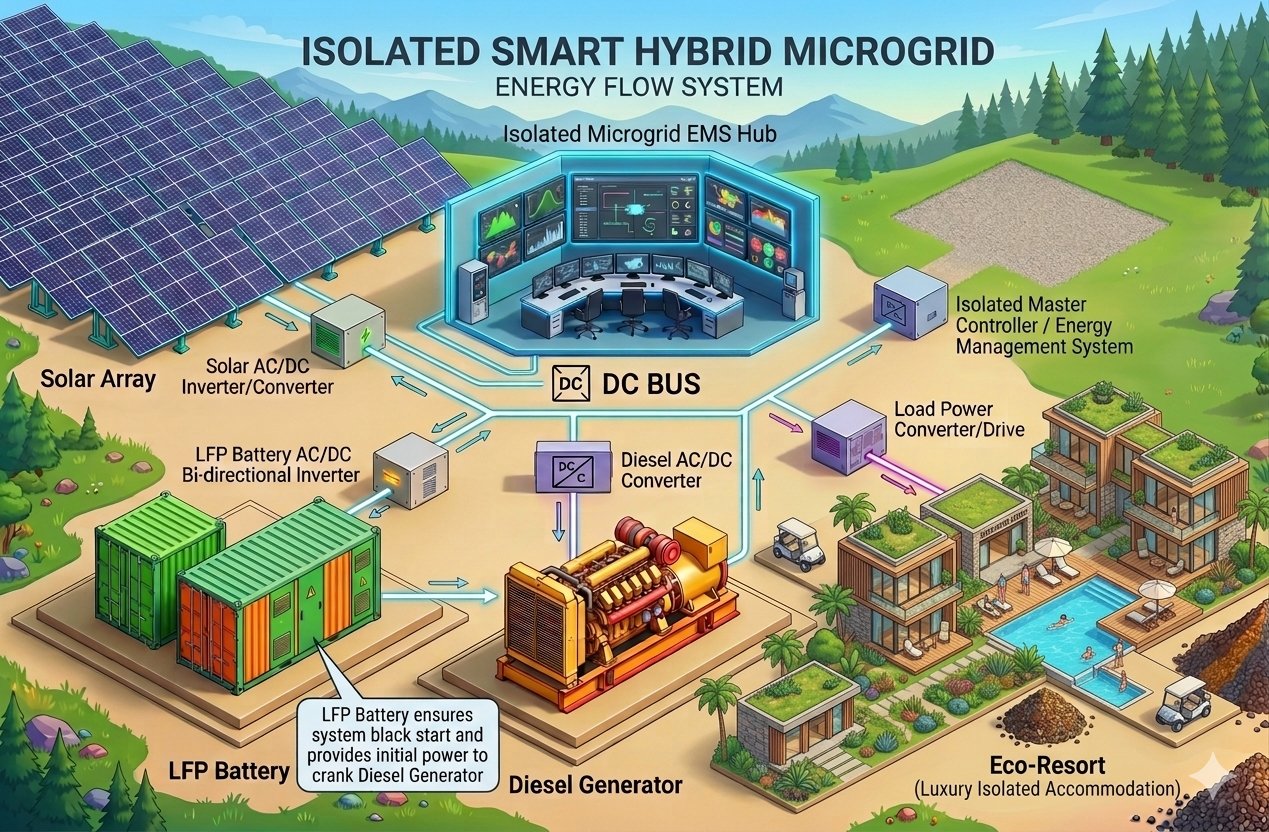
Remote and off-grid hospitality properties require silent, reliable, and sustainable power that enhances the guest experience rather than detracting from it. Our Isolated Smart Hybrid Microgrid — combining solar, LFP battery storage, and a diesel backup — delivers grid-quality power 24/7 with black-start capability and zero grid dependency.
Hybrid systems can be configured for black-start capability, load prioritisation, and resilient operation in mission-critical environments.
Remote hotels, eco-resorts, wildlife lodges, adventure parks, and nature tourism facilities face a unique challenge — they need premium, reliable power in locations where the grid either doesn't exist or cannot be trusted. Our Isolated Smart Hybrid Microgrid solves this completely.
Solar Array generates DC power through an AC/DC inverter/converter and feeds the central DC Bus during daylight hours — the primary and lowest-cost energy source.
LFP Battery Bank stores surplus solar energy via a bi-directional AC/DC inverter. At night or during cloudy periods, it discharges to power the resort load — silently and without any generator noise.
Diesel Generator activates automatically only when battery State of Charge (SoC) falls below the programmed threshold — a fraction of traditional runtime. The LFP battery provides the initial black-start power to crank the generator.
Isolated Microgrid EMS Hub — the central brain — manages solar-priority dispatch, battery SoC optimisation, load balancing, and generator scheduling through real-time SCADA monitoring.
Load Power Converter/Drive delivers stable, clean AC power to all resort loads — villas, restaurant, pool, spa, lighting, EV golf carts — at grid-quality voltage and frequency.
All systems are modular and project-specific. The ranges below should be treated as preliminary planning guidance and refined through detailed load assessment and financial analysis.
| Application | Connected Load | Solar Capacity | Battery Storage | Diesel Backup | Indicative Payback |
|---|---|---|---|---|---|
| Industrial / Mining | 150–500 kW | 300–1,000 kWp | 400–2,000 kWh | 200–600 kVA | 3–6 years |
| Food Processing / Cold Chain | 50–300 kW | 100–600 kWp | 200–1,500 kWh | 100–400 kVA | 3–5 years |
| Hospitality / Eco-Resort / Nature Park | 30–200 kW | 50–400 kWp | 100–800 kWh | 50–250 kVA | 4–7 years |
| Off-Grid Remote Facility | 20–150 kW | 40–300 kWp | 100–600 kWh | 30–200 kVA | 6–9 years |
| High Diesel Cost Scenario | Any | Tailored | Tailored | Existing | 2–4 years |
Hybrid systems can reduce diesel runtime, support peak-demand optimisation, and improve energy resilience. In one operating case, generator runtime was reduced substantially through solar-first dispatch supported by battery storage.
Commercial and industrial installations typically generate $250k–$750k in savings over a 25-year project life, depending on load profile, fuel cost, and site conditions.
Project economics vary by load profile, fuel cost, site conditions, and dispatch strategy. Our engineering team develops project-specific sizing, performance modelling, and payback analysis for each application.
Our engineers will design a project-specific hybrid power solution for your facility, supported by technical sizing and financial evaluation.
Request a System Assessment